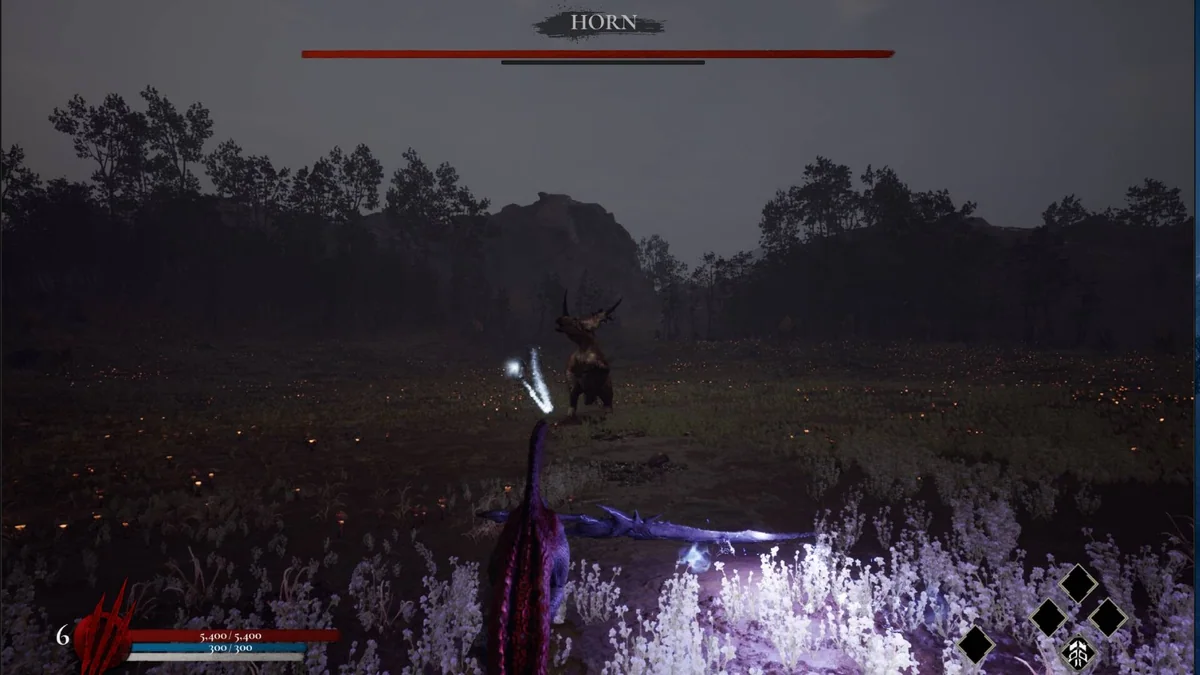
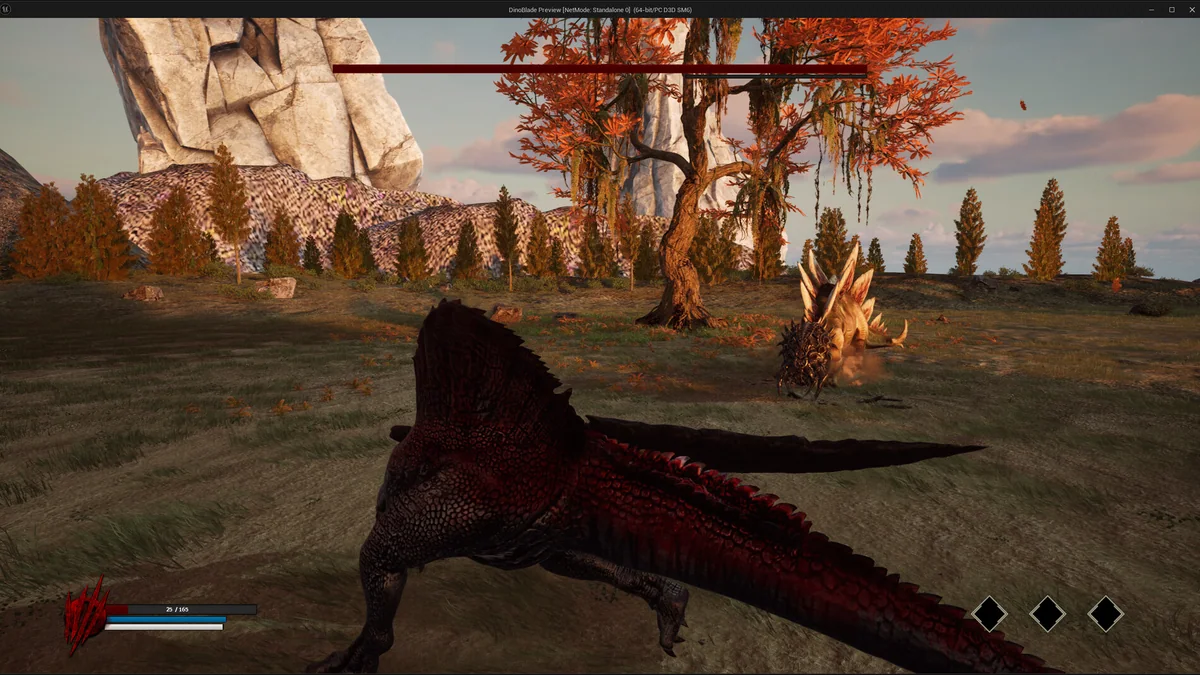
Read the strike before choosing an answer
Every attack has a sequence: preparation, release, travel, contact, and recovery. Preparation tells you what might happen; release tells you the strike has truly begun. Reacting to the first dramatic body movement can make an early dodge or parry expire before contact. Focus on the weapon head, jaw, tail, or limb that will actually cross your space, then compare it with the opponent’s center of mass.
Large models create a second problem: apparent speed changes with camera angle. An attack moving toward the lens looks different from one travelling across the screen. Keep the target and its striking tool visible, avoid fighting directly against an arena edge, and reset the camera after passing under or around a body. Target lock can help preserve orientation, but it is not a substitute for choosing a clear view.
Build recognition through controlled exposure. Let a known enemy begin an attack while you remain outside its reach. Step closer on later repetitions until you understand where contact occurs. This separates range learning from defensive timing and reduces the number of variables in each attempt.
Choose block, movement, roll, or parry for a reason
A defensive answer should solve the attack in front of you and leave a sensible next position. Block when certainty matters more than immediate advantage. Move or dodge when a small displacement clears the path and preserves control. Roll when the attack covers your current line or you need a stronger relocation. Parry when the release is readable and meeting the weapon is worth the precision risk.
Do not grade a defense only by whether it avoided damage. A roll that survives but places you against a wall may lose the next exchange. A block that preserves a centered position can be the stronger choice. A successful parry that you cannot convert safely may be less useful than simple spacing. Evaluate the entire state after the action: health, distance, orientation, recovery, and what the opponent is doing next.
Practice with a response ladder. First survive the attack by distance. Then test block. Next find a movement solution. Try a roll only when its path is clear. Attempt a parry after the release cue is familiar. The ladder makes precision the result of knowledge rather than a substitute for it.
Commit only as far as the opening allows
The official pitch encourages powerful chained attacks, but the length of an available combo depends on the target’s recovery and your position. Start each new enemy with a minimal punish. If the opponent remains unable to answer, extend the sequence on a later opening. This preserves evidence: you learn that the extra hit is safe because the prior version succeeded, not because one reckless attempt happened to work.
Skills, abilities, and weapons expand the decision tree. Classify a new option by what it changes: reach, startup, movement, pressure, interruption, resource use, or recovery. Test it in a stable encounter. A spectacular ability that ends in a vulnerable location should not become a default merely because it produces a large effect.
Position can increase damage opportunity without changing a number. Enter an opening from a line that keeps the opponent, arena center, and your escape route visible. Avoid drifting beneath a huge body unless you know how the camera behaves there. Stop a combo early when the last hit would rotate you toward an edge or hide the next cue.
Treat recovery as part of every attack
An attack is not finished when it lands; it is finished when you can defend again. Learn the recovery of your common single hit, short chain, longer chain, ability, heal, and roll. If a punish fails, ask whether you began too late, extended too far, or recovered in the wrong location. Those are different errors and require different corrections.
Use a two-exchange rule while learning: attack once, then reserve attention for the opponent’s reply. This prevents the common loop of spending every safe moment on offense and having no mental bandwidth left for the counterattack. As recognition improves, longer sequences become deliberate choices rather than automatic continuation.
Healing follows the same model. Creating distance is only the start; the opponent’s sequence must also be over, and your heal must recover before the next threat arrives. Face the enemy, confirm the pause, heal, then regain your neutral position instead of immediately attacking from a disorganized camera angle.
A practice loop that produces usable knowledge
Choose one enemy and one question. Record the attack cue in plain language, select a defense before entering range, and repeat until the outcome is consistent. Then test the smallest punish. If it works, add one variable: another hit, a different position, or a more precise defense. Never change all three at once.
When a patch changes a boss, preserve the method and discard the stale script. Official launch notes already document boss balance passes and control fixes. Check the Steam announcements, retest the cue, and update your own plan from current behavior. This is more reliable than assuming a pre-release clip still reflects the full game.
Your goal is a combat sentence you can explain: “I stayed outside the first sweep, blocked the follow-up, used one short chain during recovery, then reset toward arena center.” If your plan can be stated that clearly, it can be repeated, diagnosed, and improved.
- Read the release, not the flourish.
- Pick the defense before contact.
- Count recovery as part of the action.
- Change one variable per practice attempt.
Primary sourceOfficial Steam mechanics and patch history ↗